
FitForge · Audit + Client Report
Meta Ads · June 1–30, 2026 · USD · One shared source set
Both complete authored sample outputs are public here. “Internal Audit” identifies the intended audience.
Client campaign report / 01
FitForge Gym
Meta Ads
Client Campaign Report
June 1–30, 2026 · USD
A clear view of June.
A practical plan for the next decision.
June establishes a cost-and-volume baseline. The next priority is understanding which enquiries become useful conversations before deciding whether to increase spending.
Prepared for the FitForge owner or manager · Report reference FITFORGE-CR-2026-06 · Version 1.0 · Prepared 11 October 2026
This is a Prooflin authored sample report using a documented USD dataset. It is not a real customer result, Meta account export or live engine output. The full source files and definitions are included.
Client campaign report / 02
June in plain language
The June record shows USD 4,800 in media spend, 240,000 impressions, 4,320 link clicks and 240 recorded lead events. Those totals produce a cost per recorded lead of USD 20.00. The campaign objective is interest in a trial class or membership consultation; the data stops before confirming how those enquiries progressed.
| What to take away | Why it matters |
|---|---|
| A baseline we can inspect | The five source values reproduce the four core KPIs. Keep the same definitions for future reviews so changes can be interpreted fairly. |
| Enquiry volume is visible; commercial value is not | Recorded leads do not yet tell us how many people were contactable, qualified, attended or joined. The owner needs that distinction to judge value. |
| The next decision needs better evidence | Confirm reporting definitions and reconcile follow-up outcomes before treating the CPL as an affordable acquisition cost or an argument to scale. |
There is no comparable previous period, agreed target or approved budget ceiling in the source. June therefore cannot be labelled an improvement, a decline, good value or poor value. It can still guide a useful next conversation: who will define a valuable enquiry, who will reconcile the outcomes, and what evidence will govern a test?
Approve the measurement and follow-up work first. Discuss any test, continuation or budget change with the campaign operator using the real account context. This report does not instruct an automatic pause or increase.
Client campaign report / 03
What June covers
This report covers one aggregate Meta Ads campaign-period record for FitForge Gym, June 1–30, 2026. The objective is lead interest in a trial class or membership consultation. No particular offer, free-trial duration, membership price or campaign name is supplied.
| Accepted measure | June value | Plain-language meaning |
|---|---|---|
| M01 · Media spend | USD 4,800 | Advertising spend in the record. Agency fees, production costs and taxes are not supplied. |
| M02 · Impressions | 240,000 | Served exposure events; a person may contribute more than one. |
| M03 · Link clicks | 4,320 | Link-click events, not all clicks, unique people, sessions or verified landing-page visits. |
| M04 · Recorded leads | 240 | Campaign lead events; validity, distinct people and subsequent outcomes are unverified. |
| M05 · Reach | 96,000 | One whole-period unique-reach value for this same scope. It must not be summed across detail rows. |
The reporting period is a label, not a verified timezone cutoff. Attribution window, reporting timezone and conversion location are unavailable. No website or instant-form journey is assumed.
Read “recorded” as a count in the accepted source. Read “proposed” as a future human action. Neither label implies a campaign was changed or that a business outcome was verified.
Evidence: S01 single data row · S02 campaign context and metric definitions
Client campaign report / 04
The four KPIs, explained
These measures use the exact June totals. They show response and media cost from different angles. No target or previous-period status is attached because neither was supplied.
| KPI / result | Exact denominator | What it tells the owner |
|---|---|---|
| K01 · Link CTR 1.80% | 4,320 link clicks ÷ 240,000 impressions × 100 | The number of link-click events relative to impression events. It is not the percentage of distinct people who clicked. |
| K02 · Cost per link click USD 1.11 | USD 4,800 ÷ 4,320 link clicks | Average media spend per link-click event, rounded from USD 1.111111…. It does not price a verified website visit. |
| K03 · CPM USD 20.00 | USD 4,800 ÷ 240,000 impressions × 1,000 | Media cost per 1,000 impression events. It describes delivery cost, not lead quality. |
| K04 · CPL USD 20.00 | USD 4,800 ÷ 240 recorded lead events | Average media cost per recorded lead event. It is not cost per qualified lead or member. |
Use the full source values when calculating, then round for display. Averaging rounded daily or ad-set rates could produce a different answer. No such detail rows are included here.
USD 20.00 CPL is a useful starting point for a discussion about value. Its acceptability depends on real lead quality, follow-up outcomes, the business economics and an owner-approved target.
Evidence: S01/S02 · K01–K04; complete workings in the calculation appendix
Client campaign report / 05
Delivery & average exposure
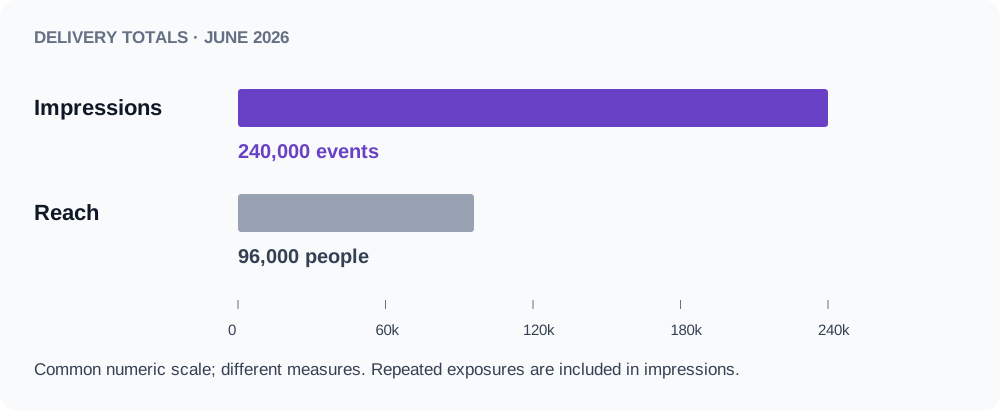
The record contains 240,000 impression events and a whole-period reach of 96,000. Dividing impressions by reach gives an aggregate mean exposure of 2.50. This is ordinary arithmetic across the accepted totals.
| What the average supports | What it does not support |
|---|---|
| A description of total exposure relative to reach | It does not show each person’s frequency, the spread of repeated exposure or how often any particular prospect saw an ad. |
| A starting point for future delivery questions | It does not establish ad fatigue, saturation, audience size, wasted impressions or a need to refresh a specific creative. |
If exposure becomes a decision point, request compatible time and creative evidence, plus the relevant distribution of frequency. Keep reach as a correctly defined whole-period measure; adding daily or ad-set reach can double-count people.
Client campaign report / 06
Response & recorded enquiries
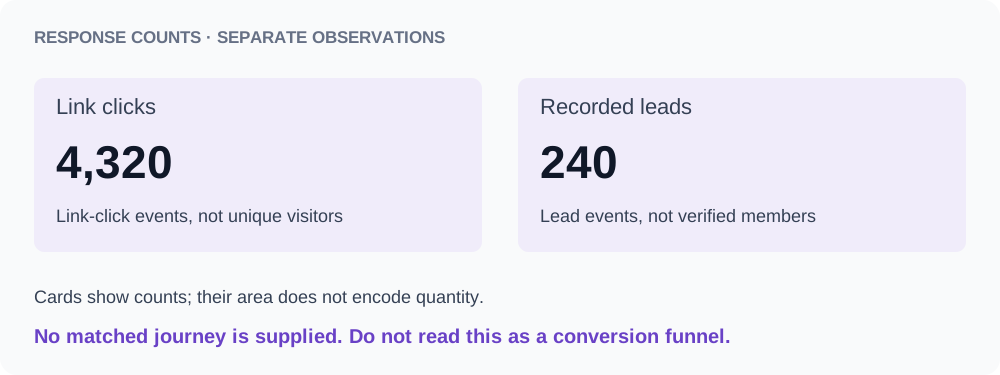
The 4,320 link-click events show link response within the reporting scope. The 240 lead events show the recorded enquiry volume. Together with impressions, the click total yields a 1.80% link CTR.
The source does not say whether a lead came through a website or an instant form, whether every lead followed a counted click, or whether the event attribution windows match. We therefore do not draw a click-to-lead conversion funnel or describe missing steps as drop-off.
Ask how “lead” is defined and where it is recorded. Keep that definition beside future exports and reports, so the campaign operator and gym team are discussing the same result.
Do not substitute all clicks for link clicks, or use recorded leads as purchases or memberships. These changes would alter the meaning of the report even if the figures looked similar.
Client campaign report / 07
One spend total, three cost views
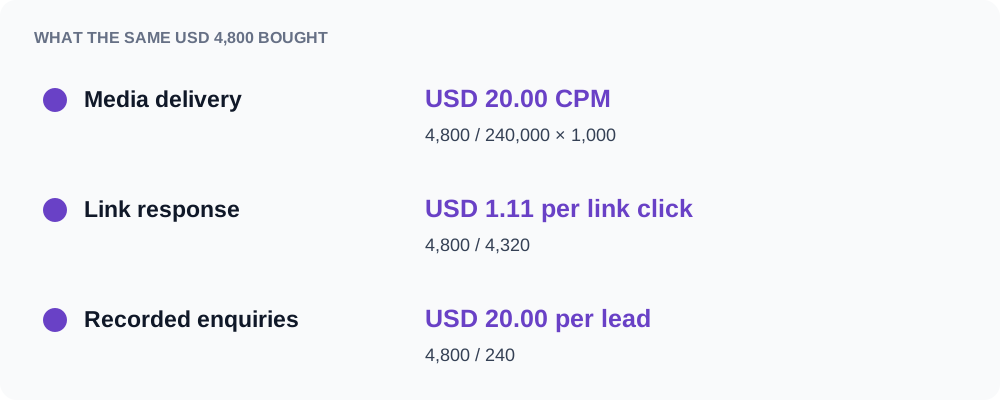
These costs are different ways to describe the same USD 4,800. They are not three separate expenses to add together. The equal USD 20.00 figures for CPM and CPL are a numerical coincidence with different units: one prices 1,000 impressions; the other prices one recorded lead event.
CPC is shown to two decimals. Multiplying the displayed USD 1.11 by 4,320 does not exactly recreate the spend because the underlying cost is USD 1.111111…. Recalculate from the source totals when reconciling.
Customer acquisition cost, membership CPA, revenue, ROAS and profitability are unavailable. Media spend is also narrower than total marketing cost because fees, taxes and production costs are not included.
Evidence: S01 M01–M04 · S02 spend definition and calculation rules
Client campaign report / 08
Highlights & opportunities
The useful highlights are the recorded activity and an inspectable baseline. They do not demonstrate a performance improvement or a winning audience or creative.
| Observation | Balanced interpretation | Opportunity |
|---|---|---|
| 240 recorded lead events | An enquiry count is available, but distinct and useful prospects are not yet established. | Reconcile validity and follow-up outcomes so future reports can connect volume with business relevance. |
| Four KPIs reproduce from five inputs | The arithmetic is consistent. That is a reporting strength, not independent verification of the campaign or account. | Keep the June source and definitions unchanged as a reference for future reconciliations. |
| One shared period and USD currency | The report avoids combining incompatible periods or currencies. | Confirm timezone and attribution settings before adding a comparison month. |
| No detailed segment or creative evidence | No winner, weak segment or daily trend can be named fairly. | Collect compatible breakdowns only where they will inform an approved test or allocation decision. |
The main challenge is outcome visibility. Additional clicks or cheaper lead events could still be accompanied by poor fit or incomplete follow-up. Conversely, the absence of those outcome records does not prove the campaign produced poor-quality enquiries.
Focus first on the information that would change a decision. A clear definition of a valuable enquiry and a reconciled follow-up view are more useful here than an unsupported “good” or “bad” label.
Evidence: S01/S02; missing outcomes, comparison and dimensions
Client campaign report / 09
Make lead quality discussable
The next report should help the owner distinguish an event count from a useful enquiry. The following is a proposed review process for the gym team and campaign operator; it is not a description of June outcomes or a connected CRM feature.
| Proposed step | Responsible role | Evidence to retain |
|---|---|---|
| Agree what qualifies | Gym owner / manager | A written, practical definition of valid contact and relevant trial-class or consultation interest. Do not assume every recorded event qualifies. |
| Define one cohort | Campaign operator + reporting analyst | Source period, attribution window, conversion location and a consistent rule for matching leads to follow-up records. |
| Record progress | Reception / sales lead | Aggregate counts for reached, pending, uncontactable, invalid or duplicate, qualified, attended and joined, with definitions and observation dates. |
| Reconcile exceptions | Reporting analyst + gym manager | Unmatched records, duplicate handling, missing statuses and pending outcomes. Retain unknowns instead of forcing a complete funnel. |
Stages may overlap or occur at different times. Agree whether a count is a current status or a cumulative event before calculating a rate. A lead that is still pending should not be automatically classified as unsuccessful.
Keep individual contact details in the business’s authorized private process. This report needs aggregate, reconciled counts and definitions, not names, phone numbers or personal correspondence.
Once a defined cohort has compatible outcome evidence, a later reviewer may evaluate qualification or membership economics. June’s source does not yet support those calculations.
Evidence: S02 missing lead outcomes and attribution; proposed response to those gaps
Client campaign report / 10
Work completed: what is documented
No campaign activity log or delivery notes were supplied for June. We cannot verify which ads were launched, budgets changed, audiences adjusted, enquiries contacted or tracking settings checked. The absence of a log does not mean no work occurred.
| Campaign execution | Preparation of this report |
|---|---|
| Not documented in the supplied source. No media-buying or agency-work claim is made. | The approved source files were preserved, figures reconciled and ordinary KPIs calculated. |
| No completed creative test, optimization or follow-up activity can be attributed. | The report presents the confirmed meanings, relevant limitations, and proposed decisions and next-month work. |
| Any future claim of completed work needs a dated record and responsible person. | The charts explain the accepted numbers; they are not screenshots or evidence of account changes. |
For the next reporting cycle, ask the operator for a brief dated change log: action, reason, responsible role, approval and the evidence used to review it. A change log should record what happened without automatically attributing a later result to that change.
When the work log arrives, add the verified activities as a separately sourced update. Keep this baseline intact and clearly label any new report version.
Evidence: S02 supplied-source boundary; no campaign work log
Client campaign report / 11
Five practical recommendations
These priorities preserve the June findings while making the next steps concrete. They are proposed work, not completed optimizations or guarantees.
| Priority / action | Why this comes next | Completion evidence |
|---|---|---|
| R01 · Protect the baseline Reporting analyst | A change in definitions can look like a change in performance. | Frozen source retained; five measures and four KPIs independently reproduced; revisions versioned. |
| R02 · Confirm measurement Campaign operator | Attribution, timezone and conversion location determine whether counts can be compared. | Exact settings and event definitions documented with the reporting scope. Link clicks remain distinct from all clicks. |
| R03 · Reconcile lead outcomes Gym manager + analyst | CPL alone cannot show the usefulness of enquiries. | Agreed valid/qualified definitions and a reconciled cohort with pending, duplicate and unmatched records visible. |
| R04 · Prepare one bounded test Operator + owner | There is no evidence to name a winner or justify broad allocation changes. | A single hypothesis, confirmed offer, measurement plan, owner-approved spending authority and stop/review rules. |
| R05 · Review before scaling Owner + operator | No target, commercial outcome or approved ceiling supports a scale decision today. | Comparable evidence and business criteria reviewed together; decision and approval recorded. |
R01–R03 are the immediate evidence priorities. R04 depends on those definitions and the actual account context. R05 is a decision gate, not a planned budget increase.
Evidence: S01/S02; accepted figures and documented evidence gaps
Client campaign report / 12
The decisions for the owner
The report supports an evidence plan now. It does not establish an appropriate budget, prove that the campaign should be paused, or provide a basis to scale.
| Decision | Proposed owner position | Before approval |
|---|---|---|
| Who owns the follow-up review? | Assign a gym contact and a campaign operator to agree definitions and reconcile outcomes. | Confirm responsibilities and access to the business’s existing private records. |
| Should activity continue? | Review with the operator against the real account state and existing authority. June alone does not settle it. | Check current constraints, service capacity, approved spending authority and measurement reliability. |
| Is a test appropriate? | Consider a limited, clearly defined hypothesis after the evidence requirements are met. | Approve the offer, measurement, review point and spending controls. No amount is proposed here. |
| Should spending increase? | Defer a scale recommendation on this evidence. | Require meaningful outcome evidence, compatible comparison, business thresholds and a documented owner decision. |
No automated action is attached to this report. A person with account authority must approve and implement any test or spending change.
The business need is not simply “more leads.” It is a better-supported decision about the relationship between media spend, relevant interest and the gym’s ability to serve that interest. Define that standard before judging a future result.
Evidence: S02 unavailable targets, ceiling, lead outcomes and comparison
Client campaign report / 13
Next month: establish the foundation
The next reporting month means the cycle after this report is received and approved. These are proposed phases, not July results, calendar bookings or completed work. The first three priorities create the conditions for a useful review.
| Priority / owner | Proposed work and dependency | Success / decision criterion |
|---|---|---|
| P1 · Agree the reporting contract Owner + campaign operator | Before comparing or testing: confirm objective, period, timezone, attribution, lead event, conversion location and exact click type. | Both sides approve one set of definitions. If an item remains unknown, document the restriction and hold any conclusion that depends on it. |
| P2 · Preserve and reconcile Reporting analyst | Use the accepted June files and compatible next-cycle exports. Keep raw values, revisions and the same currency; reconcile totals before rates. | Totals and units reconcile; differences are explained. A mismatched definition triggers separate reporting, not a misleading trend. |
| P3 · Add outcome visibility Gym manager + reception lead | Agree a lead-quality definition and a private follow-up process. Analyst helps define one cohort and an observation cutoff. | Every reviewed record has a defined status or an explicit unknown; duplicates, pending and unmatched counts are retained. Missing does not become zero. |
A complete evidence record is the success criterion for these preparation steps. A lower CPL is not the measure of whether the measurement work was completed correctly.
Start with the minimum information needed to change a decision. Do not collect personal details in the public report or add elaborate reporting that the gym cannot maintain.
Dependencies: owner/operator availability; access to authorized source settings and aggregate follow-up evidence. None of these inputs is represented as already collected.
Client campaign report / 14
Next month: test, then review
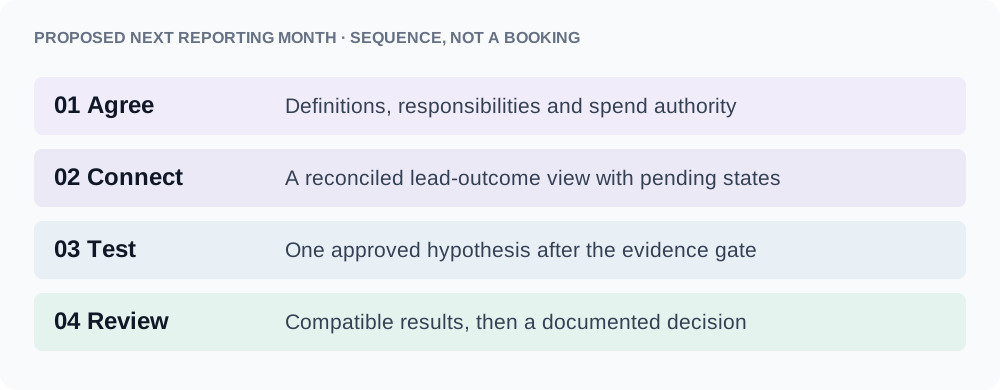
| Priority / owner | Dependency and proposed action | Decision criterion |
|---|---|---|
| P4 · Prepare one test Operator + owner | After P1–P3: confirm the real offer and select a single message-intent hypothesis. Agree measurement and account controls. | Brief approved before launch. If measurement or offer validity is unresolved, do not begin the test. |
| P5 · Review the evidence Analyst + gym manager | Collect compatible media totals, aggregate lead outcomes, pending states and a dated work log. | Distinguish a reporting change from a campaign change; mark insufficient or immature evidence as inconclusive. |
| P6 · Choose the next action Owner + operator | Use the agreed business criteria and actual account constraints to assess the evidence. | Record continue, revise, stop or further-observe with reasons. Scaling remains conditional on sufficient evidence and explicit approval. |
The plan proposes no new budget amount, uplift promise or automatic optimization. Timing and test duration must reflect the actual volume, outcome lag and business capacity agreed by the people responsible.
Client campaign report / 15
A proposed test brief
The objective includes two forms of interest: a trial class and a membership consultation. A useful hypothesis is that clearer enquiry intent may change both response and the usefulness of follow-up. No existing ad artwork or copy was supplied, so this is not a creative critique.
| Brief item | Proposed specification |
|---|---|
| Question | Does clearer trial-class or consultation intent help the gym understand and respond to enquiries? |
| Message directions | Trial-class interest: invite a question about trying a class. Consultation interest: invite a conversation about membership options. These are hypotheses, not approved offers or measured winners. |
| Before launch | The owner confirms what is genuinely available and approves wording. The operator defines the comparison, keeps other conditions as consistent as practical, and documents unavoidable differences. |
| Measures | Use the defined media KPIs alongside compatible validity, qualification and follow-up outcomes. Preserve pending and unmatched results. |
| Controls | Agree spending authority, observation window, sufficient evidence requirements, stop/review rules and responsible roles. No specific amount or performance threshold is invented here. |
| Interpretation | Compare like for like. If allocation or audiences differ materially, treat the result as observational rather than proof the wording caused a change. |
If the prerequisites cannot be met, retain this as a proposal and improve the evidence first. Do not launch merely to populate the next report.
Evidence: S02 objective and missing creative/outcome context; proposed hypothesis
Client campaign report / 16
What the next review should resolve
The next meeting should end with a documented decision, even if the appropriate decision is to wait for better evidence. Use the following agenda to connect campaign reporting with the gym’s actual needs.
| Review question | Evidence required | Decision it can support |
|---|---|---|
| Are we comparing the same thing? | Same scope, currency, click/lead definitions, attribution and timezone; any change explained. | Accept the comparison, separate the periods or request a correction. |
| Are enquiries useful and followed up? | Defined cohort; aggregate valid/qualified/contacted outcomes; observation cutoff; pending and unmatched records. | Improve follow-up, refine qualification or gather more evidence. |
| Was proposed work actually done? | Dated log with action, responsible role, approval and review evidence. | Report verified work without inventing activity or claiming causation. |
| Did the test answer its question? | Approved brief, comparable data, outcome maturity and documented differences. | Continue, revise, stop or mark inconclusive against criteria agreed in advance. |
| Is a spending change justified? | Business target, meaningful outcome evidence, capacity, actual account constraints and approved ceiling. | Owner decision; no automatic scale recommendation from a cheaper CPL alone. |
Prepare the media export, source definitions, aggregate outcome reconciliation and work log together. Label what is missing before the meeting so uncertainty is not mistaken for a zero result.
If no meaningful comparison or outcome evidence is available, preserve June as a baseline and keep the next decision bounded. A clear “not yet established” is more useful than an unsupported success claim.
Client campaign report / 17
Evidence & source register
Two source files contain the complete accepted numerical record and definitions. They are reproduced in the following appendices and available as standalone downloads. No hidden campaign evidence supports a stronger conclusion.
| Source | Content and use | Download |
|---|---|---|
| S01 · Frozen CSV | One header and one data row containing five aggregate measures. It supplies every observed June figure. | Download source CSV |
| S02 · Source record | Origin, campaign context, metric definitions, acceptance decisions, calculation rules and limitations. | Download source record |
Open the complete source gallery
S01 SHA-256ed9ac95aef4fbc63a52ecb3654c52484ea05edd912eb8c05b2bfc612b372ff45
S02 SHA-2567210e53e935b390893008849d5fd6fa5dea84648b3e872f92d66ec23fff5e721
A hash identifies the exact file version; it does not verify that the values came from a real advertising account. S02 is an authored definition/confirmation record, not an application audit log.
The report distinguishes source totals (M01–M05), ordinary derived KPIs (K01–K05), interpretation and proposed actions (R01–R05; P1–P6). The actions do not add new measured evidence.
If a source, definition or reporting scope changes, retain the original, explain the change and issue a new version for the affected conclusions.
Client campaign report / 18
Appendix · the complete CSV
S01 · FitForge-June-2026-USD-confirmed-metrics.csv
| Spend | Impressions | Link clicks | Leads | Reach |
|---|---|---|---|---|
| 4800 | 240000 | 4320 | 240 | 96000 |
This is the full data row, shown without display rounding. Spend is in USD; the other columns are counts. The CSV is preserved byte-for-byte from the approved June source.
| Source label | Interpretation retained |
|---|---|
| Spend | Media spend only. No total marketing cost or customer-acquisition-cost claim. |
| Impressions | Exposure events, including possible repeated exposures. |
| Link clicks | Link-click events only. No substitution with all clicks, sessions or unique visitors. |
| Leads | Recorded campaign lead events; no substitution with purchases, qualified leads or memberships. |
| Reach | Whole-period reach in the same scope. Not an additive daily/ad-set metric. |
There are no additional rows to rank by audience, ad set, placement, creative or date. A graph cannot recover a dimension that the source does not contain.
Download the original CSV bytes
S01 SHA-256ed9ac95aef4fbc63a52ecb3654c52484ea05edd912eb8c05b2bfc612b372ff45
Source appendix / 19
Appendix · source record, part 1
S02 · Complete original text, continued on the next page.
FITFORGE — SOURCE DEFINITION AND CONFIRMATION RECORD
Record S02 | Version 1.0 | Authored 11 October 2026

ORIGIN
This is an authored sample dataset for a Prooflin sample report. It is not a
real Meta Ads Manager export, account screenshot, live result or customer case
study. Values were created in USD from first principles, not converted from another currency.
No source image, OCR run, model generation, platform verification or actual
campaign-management action is claimed. Meta does not endorse this sample.

CAMPAIGN CONTEXT
Business: FitForge Gym
Platform label: Meta Ads
Objective: leads — trial-class / membership-consultation interest
Reporting period: June 1–30, 2026, inclusive (reporting label)
Currency: USD; all monetary amounts are USD
Scope: one aggregate campaign-period record; no subtotal, total or detail mixture
Attribution window: not supplied
Reporting timezone: not supplied; no hourly or timezone-specific conclusions
Conversion location: not supplied; do not infer instant form or website funnel
Comparison period / business target / approved budget ceiling: not supplied

S01 FROZEN CSV / ACCEPTED VALUES
M01 Spend = 4800 USD, media spend only; taxes, agency fees and production costs
are not supplied. Do not call this total marketing cost or customer acquisition cost.
M02 Impressions = 240000 served impression events in this campaign-period scope.
Repeated exposures may contribute; this is not a unique-person count.
M03 Link clicks = 4320 link-click events. It is not all clicks, unique clicks,
landing-page views, sessions or confirmed website visitors. The accepted source meaning remains link clicks throughout this report.
M04 Leads = 240 recorded campaign lead events. Distinct people, valid enquiries,
qualified prospects, attended trials, memberships and offline sales are unverified.
M05 Reach = 96000 whole-period unique-reach sample value in the same scope.
Do not sum reach across days, ad sets or creatives. No row-level reach supplied.
Source appendix / 20
Appendix · source record, part 2
CONFIRMATION DECISIONS (AUTHORED RECORD, NOT AN APP AUDIT LOG)
C01 Accept the single CSV data row and the five meanings above for this sample.
C02 Keep Link clicks as the only clicks denominator; no all-click substitute.
C03 Do not enter Leads as Conversions or Purchases. Those outcomes are unknown.
C04 Accept Reach once at the whole-period level; no summed-reach calculation.
C05 Numerical corrections: none. The frozen row reconciles without editing values.
C06 Exclude unrelated datasets, claimed creative/ad-set winners and
unverified screenshot/OCR evidence. They are not sources for this USD audit.
C07 A changed source, period, currency or definition requires a new confirmation.

CALCULATION RULES
K01 Link CTR = M03 / M02 = 0.018 ratio = 1.80 percent.
K02 Cost per link click = M01 / M03 = 1.111111... USD, displayed USD 1.11.
K03 CPM = M01 / M02 * 1000 = 20 USD per 1000 impressions.
K04 CPL = M01 / M04 = 20 USD per recorded lead.
K05 Mean frequency = M02 / M05 = 2.50 impressions per reached person; this is an
aggregate average, not each person's exposure count or evidence of fatigue.
Do not calculate membership CPA, ROAS or a conversion rate without defined,
compatible and confirmed inputs. Missing outcomes are unavailable, never zero.

LIMITS
No actual creative assets, audience, placement, device, daily, landing-page,
CRM, revenue, attribution or account-settings evidence. No performance target,
comparable previous period, industry benchmark or causal experiment. All report
recommendations are proposed customer actions requiring human review.
Client campaign report / 21
Appendix · calculation workings
Calculate from the exact base totals, then round for display. Currency and rate presentation uses two decimal places. These are ordinary KPI formulas, not a proprietary score.
| Measure | Working | Displayed result |
|---|---|---|
| K01 · Link CTR | 4,320 ÷ 240,000 = 0.018 0.018 × 100 | 1.80% |
| K02 · Cost per link click | USD 4,800 ÷ 4,320 = USD 1.111111… | USD 1.11 |
| K03 · CPM | USD 4,800 ÷ 240,000 × 1,000 | USD 20.00 per 1,000 impressions |
| K04 · CPL | USD 4,800 ÷ 240 | USD 20.00 per recorded lead |
| K05 · Mean exposure | 240,000 ÷ 96,000 | 2.50 impressions per reached person |
K05 is an aggregate average, not a frequency distribution or proof of fatigue. Every ratio uses the same accepted period-level scope; there is no average of detail-row ratios.
240 ÷ 4,320 × 100 = 5.56% is only a same-period quotient. It is not a verified conversion rate because matched journeys, conversion location and compatible attribution definitions are missing. It is excluded from the headline KPI set.
Membership CPA needs a defined, compatible membership count; qualified-lead cost needs qualified leads; ROAS needs compatible revenue. Those inputs are unavailable. No value is calculated by treating missing data as zero.
Client campaign report / 22
Methodology & material limits
This report preserves the approved source definitions, reconciles the five aggregate values, calculates ordinary KPIs and presents their meaning for a gym owner. Proposed actions are based on the information needed to make the next decision; they are not proof of campaign work or future results.
| Evidence boundary | Implication |
|---|---|
| Authored source, not an account export | Arithmetic can be checked, but this is not a real customer case study, platform verification or model/engine run. |
| One period and aggregate scope | No change percentages, trends, benchmarks, target attainment, segment rankings or creative winners are established. |
| Definitions not fully supplied | Attribution window, reporting timezone and conversion location must be confirmed before compatible comparisons or conversion conclusions. |
| Commercial outcomes unavailable | Distinct/valid/qualified leads, follow-up, attendance, memberships, purchases, revenue, ROAS and profitability remain unknown. |
| No activity log or current account state | No completed optimization, budget change, test or agency-work claim; no automatic pause, continuation or scale instruction. |
The precision of a calculation is separate from the reliability of a real-world source or the strength of a business conclusion. An exact USD 20.00 CPL does not, by itself, establish affordability or profitability.
Use this report to agree definitions, responsibilities and evidence. With that foundation, the next review can support a better-informed human decision about campaign activity.
FITFORGE-CR-2026-06 · Version 1.0 · Prepared 11 October 2026
Complete report, frozen source CSV and full source record included.